
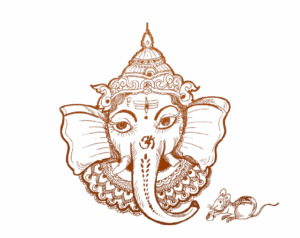
Every Hindu household knows Gaṇeśa. He sits at the threshold of every rite, red or saffron, round of belly, a sweet in one hand, the remover of obstacles who is worshipped first so that everything after Him goes well. He is the most domesticated of the gods, the one children learn to draw before they can read.
Ucchiṣṭa Gaṇapati is the same god seen from the other side of the door.
His name means the Gaṇapati of the leftover, of the remnant, of the food that has already touched the mouth. He is worshipped in the state that ordinary ritual spends most of its energy avoiding: unbathed, with food still on the tongue, the rules of tithi and nakṣatra set aside. In His iconography He holds His Śakti on His lap, and the texts are frank about the intimacy. He is the patron of one of the six historical Gāṇapatya schools, the one the orthodox commentators liked least. And He is, according to the tradition that keeps Him, a giver of speech, of knowledge, of every kind of fulfilment, and a direct road to the recognition that nothing whatever stands outside the sacred.
This article looks at who He is, where He comes from, what the sources actually say, and what the teaching underneath the taboo might be.
The word first: ucchiṣṭa
The Sanskrit ucchiṣṭa (from ud plus the root śiṣ, to leave over) has two lives, and the whole meaning of this deity lies in the gap between them.
In the Vedic period the word is exalted. The Atharvaveda devotes a complete hymn, Book 11, hymn 7, to Ucchiṣṭa, the remnant of the sacrifice, and the poet does not treat it as waste. The hymn describes the remnant as containing name and form and world, heaven and earth, being and non being, Indra and Agni and Prajāpati, and the sacred texts themselves. The remnant is what remains when everything has been offered and consumed, and precisely for that reason it is treated as the substrate of the whole. Scholars of Vedic ritual note that ucchiṣṭa here functions as the foundation of the cosmos rather than its refuse. In the technical literature of sacrifice the remnant of the offering (śeṣa, ucchiṣṭa) is handled with care and distributed, because what is left after the gods have eaten is still charged with the rite.
By the time of the dharmaśāstra, the word has been inverted. Ucchiṣṭa now means the state of a person who has eaten and has not yet washed, the food touched by saliva, the plate someone else has eaten from. It is a category of pollution. A person who is ucchiṣṭa may not touch the sacred, may not recite, may not enter the shrine until water has been taken and the mouth rinsed. Whole economies of caste and commensality were built on who could receive whose leftovers.
So the same syllables name both the residue that holds the universe together and the residue that must be washed off before one may approach God. Ucchiṣṭa Gaṇapati stands exactly at that fault line. His worship is a deliberate return to the first meaning through the door of the second.
What the texts describe
Ucchiṣṭa Gaṇapati is listed among the thirty two forms of Gaṇeśa (dvātriṃśat gaṇapati) preserved in the Śrītattvanidhi and popularised through South Indian temple sculpture, where He is usually counted eighth. The iconographic manuals do not agree with one another in detail, and it is worth being honest that no single canonical image exists.
The Mantramahārṇava describes Him as red, four armed, holding bow, arrow, noose and goad, and states plainly that He should be shown in the act of union with His Śakti. The Uttarakāmikāgama describes Him as dark, four armed, with a jewelled crown and a third eye, holding noose, goad and sugarcane, with the Devī on His left lap named Vighneśvarī and prescribed to be sculpted as a beautiful young woman. The Kriyākramadyotī gives a six armed form holding a lotus (often a blue lotus), a pomegranate, a vīṇā, a rosary and a rice sprig, and names Him a giver of great boons. Some later descriptions give His colour as blue.
Gopinatha Rao, whose Elements of Hindu Iconography remains the standard survey, classes Him among the five Śakti Gaṇapati forms, and observes that sculptures rarely follow any of the textual prescriptions exactly. What sculptors consistently show is a seated four armed Gaṇapati with noose, goad and a sweet, His fourth arm around the hip of an unclothed goddess seated on His left thigh, who holds a lotus or flower. In many images the tip of His trunk rests at Her yoni. In some she touches His liṅga. Thomas Donaldson's survey of tantric art in Orissa documents these images in some number, and notes that the explicitly erotic treatment is confined to the four armed form.
Lawrence Cohen, writing in Robert Brown's collection Ganesh: Studies of an Asian God, makes a useful observation. In many ordinary Śakti Gaṇapati images the goddess holds a bowl of modaka in her lap and the god's trunk reaches into it. The Ucchiṣṭa image simply removes the bowl. The gesture of appetite that every child recognises in Gaṇeśa, the trunk reaching for the sweet, is allowed to reach the goddess herself. The pomegranate He holds, a fruit that bursts with seed, belongs to the same field of meaning: fertility, abundance, the generative. The tradition reads this as the oneness of Gaṇeśa and the Devī, the inseparability of the god and His power, made visible without euphemism.
Two well known shrines keep His image today. In Tirunelveli in Tamil Nadu there is a temple to Ucchiṣṭa Gaṇapati where He is petitioned above all for children. In the great Jagannātha temple at Puri, the shrine known as Kāñcī Gaṇeśa houses an Ucchiṣṭa Gaṇapati (also called Bhaṇḍa Gaṇapati and Kāmada Gaṇapati) which tradition says was carried from Kāñcīpuram as spoils of war by the Gajapati king Puruṣottama Deva in the late fifteenth century. Both are living temples, not museum pieces, and in both the god is approached as a giver of exactly the fruits householders want.
The sect that carried Him
The primary historical source for the Gāṇapatyas, the sects that worshipped Gaṇeśa as the Supreme Reality rather than as a doorkeeper for other gods, is the Śaṅkaravijaya attributed to Ānandagiri. Its date is disputed; scholars place it anywhere from the tenth to the fourteenth century. It describes six Gāṇapatya schools, each devoted to a different form, and has Śaṅkara debate and defeat their exponents in turn.
The exponent of the Ucchiṣṭa Gāṇapatyas is named as Heramba Suta. The text attributes to him a set of positions that the orthodox author clearly intends to shock: no caste distinction among worshippers, the ordinary rules governing marriage and sexual relations not binding, adherence to conventional rites left to the individual's choice, worship conducted in the ucchiṣṭa state, and the use of the substances later systematised as the five makāras. Adherents wore a red mark on the forehead. R. G. Bhandarkar, in his Vaiṣṇavism, Śaivism and Minor Religious Systems (1913), judged the whole complex to be an imitation of Kaula Śākta worship transposed onto Gaṇeśa. Later scholars such as Shanti Lal Nagar agree that the iconography bears an unmistakably Kaula stamp.
Two cautions belong here. First, the Śaṅkaravijaya is a polemical text. It is describing opponents it wishes to see defeated, and it is a hostile witness. What the Ucchiṣṭa Gāṇapatyas said about themselves has largely not survived, and the practice manuals that circulate today (an Ucchiṣṭa Gaṇapati Pūjāvidhāna, the relevant sections of the Mantramahārṇava and Śāradātilaka, and modern compilations) reflect the mainstream tantric handbook tradition, not the sect as Ānandagiri portrays it. Second, some sources also connect the deity to the six acts of abhicāra, the aggressive uses of mantra, which is a reminder that in the tantric world power is not pre sorted into acceptable and unacceptable uses. This is a strand of the tradition, not a recommendation, and it is one reason the transmission has always been kept under a guru.
There is also a quieter, quite different way of reading the epithet. Several traditional commentators derive ucchiṣṭa from uccha plus śiṣṭa, the highest remainder, that which is left when everything else is subtracted, and take the name to mean the Ultimate. On this reading the polluted leftover and the Supreme Remnant of the Atharvaveda are one word after all, and the god's name is a small koan: what remains when you have given everything away?
How He is worshipped
The tantric handbooks describe a practice that reverses nearly every convention of Brahmanical pūjā, and does so on purpose.
The sādhaka worships without bathing. The last morsel of a meal is kept in the mouth, or the mouth is left unrinsed, so that the offerer is in the very state that would bar entry to any other shrine. The texts state that no rules of lunar day, asterism, fasting or purification apply. Tāmbūla (betel) is offered and taken. Some lineages perform the worship unclothed. The mantra, which the compilations describe as kept secret in all the Tantras and revealed for the world's benefit, is received from a teacher; the printed versions vary by lineage, and a reader who has met the mantra online should understand that a sequence of syllables in a book is not the same as a mantra given by a living transmission. The Śakti of this form is named as Nīlasarasvatī, and in the Śākta systems the same goddess appears as Mātaṅgī, the Mahāvidyā of the outcaste and of true speech, who is herself called Ucchiṣṭa Cāṇḍālinī and receives the leftover as her chosen offering. The two cults share a logic, a colour field, and a promise: vāk siddhi, mastery of speech and of learning, is the classic fruit.
The stated fruits are worldly and generous. The Kriyākramadyotī calls Him a giver of great boons. Temple traditions ask Him for progeny. The compilations promise that whatever the worshipper desires is fulfilled. This should not be softened for a Western readership: the tradition does not apologise for bhukti. It holds that enjoyment and liberation come from one source, and that a path which cannot grant the first is unlikely to be trusted with the second.
What the taboo is for
It is easy to read the Ucchiṣṭa cult as a scandal, and Ānandagiri wanted us to. It is also easy, in the opposite direction, to read it as a licence, and modern marketing sometimes wants us to. Both readings miss the operative idea.
Every system of purity is a system of separation. It draws a line between the body and the sacred, between the eaten and the offerable, between those who may approach and those who may not, and it keeps the line by disgust. Disgust is a real thing. Psychologists who have studied it, Paul Rozin and colleagues most thoroughly, have shown that it follows a logic of contagion, that it treats contact as contamination, that it is learned in childhood and is extraordinarily stable, and that it extends from food and bodily fluids outward into social and moral judgement. It is one of the most powerful mechanisms the human mind has for saying: not this, not here, not me. That much is well established science.
Now consider what the tantric practitioner is doing. She is choosing, in full awareness, to stand before the Divine in the one condition her whole formation has taught her makes her unfit to do so. She keeps the food in her mouth. She does not wash. She looks at an image in which the god's appetite is not disguised. And she offers worship anyway, and finds, the tradition says, that the god receives it.
What that does, if it works, is not to abolish disgust but to expose it as a movement of mind rather than a property of the world. The line between pure and impure turns out to be drawn by the one who is looking. This is the central tantric claim, and it is a claim of the non dual traditions, not a finding of neuroscience: that the same awareness which shrinks from the leftover and the same awareness which shines in the deity are one awareness, and that the shrinking is the only thing in the way. Abhinavagupta says it in the Śaiva idiom; the Kaula texts say it in the idiom of the forbidden substances; Ucchiṣṭa Gaṇapati says it with a sweet in His hand and His consort on His knee.
This is why the leftover was chosen and not some neutral object. If the sacred can be found in the one place you were certain it could not be, the search is over everywhere. The remnant that the Atharvaveda called the foundation of the worlds is simply reality itself, seen after the mind has stopped subtracting.
Notice also what the cult does with the god who guards the threshold. Gaṇeśa is Vighneśvara, Lord of obstacles, who both places them and removes them. The most stubborn obstacle on any contemplative path is not a circumstance but a boundary in the practitioner's own sense of what is allowed to be holy. Ucchiṣṭa Gaṇapati is the remover of that obstacle in particular. The threshold god is worshipped at the threshold of the practitioner's own disgust, and the threshold opens inward.
Reading Him honestly
A few things need to be said plainly, because this deity attracts more speculation than most.
Nothing in the historical record supports the idea that the Ucchiṣṭa Gāṇapatyas were an ancient Vedic school. Gaṇeśa Himself does not appear in the Vedic corpus in His elephant headed form; the Ucchiṣṭa hymn of the Atharvaveda is about the sacrificial remnant, not about Him, and the connection between them is a later theological reading, meaningful but not philological. The sect belongs to the medieval tantric world, roughly the same centuries that produced the Kaula Śākta systems it resembles.
The erotic iconography is not a modern invention or a corruption. It is prescribed in the texts and attested in stone across South India and Orissa. Attempts to explain it away as purely allegorical are as much a distortion as attempts to read it as pornography. The tradition means what it shows: the god and His Śakti are not two.
The claim that His worship dispenses with all rules is a claim about a specific ritual system, made within a tradition that retains the guru, the mantra, the dīkṣā and the discipline of regular practice. Freedom from the rules of purity is not freedom from method. Every source that transmits this deity also insists on transmission.
And the promise attached to Him, that He accepts whatever is offered and does not judge, is worth taking seriously as a spiritual fact rather than a slogan. Most of what a person carries that they consider unofferable, the unrespectable history, the appetite, the unfinished, the parts of themselves left on the plate, has never been placed before anything holy, because it did not seem to qualify. Ucchiṣṭa Gaṇapati is the form of the Divine to whom exactly those things are brought first. What He teaches, before any siddhi, is that they were never disqualified.
He is the same Gaṇeśa the children draw. He has only turned around at the door and asked to be met on the other side of it.
Sources and further reading
- Brown, Robert L., ed. Ganesh: Studies of an Asian God. Albany: SUNY Press, 1991. Especially Lawrence Cohen, "The Wives of Gaṇeśa," and James H. Sanford, "Literary Aspects of Japan's Dual Ganeśa Cult."
- Bhandarkar, R. G. Vaiṣṇavism, Śaivism and Minor Religious Systems. Strassburg, 1913; reprinted New Delhi: Asian Educational Services, 1995. Pages 211 to 213 on the Gāṇapatyas.
- Bühnemann, Gudrun. Forms of Gaṇeśa: A Study Based on the Vidyārṇavatantra. Wichtrach: Institut für Indologie, 1989.
- Donaldson, Thomas E. Tantra and Śākta Art of Orissa. New Delhi: D.K. Printworld, 2002. Pages 804 to 805.
- Krishan, Yuvraj. Gaṇeśa: Unravelling an Enigma. Delhi: Motilal Banarsidass, 1999.
- Nagar, Shanti Lal. The Cult of Vinayaka. New Delhi: Intellectual Publishing House, 1992.
- Rao, T. A. Gopinatha. Elements of Hindu Iconography, vol. 1 part 1. Madras, 1914; reprinted Delhi: Motilal Banarsidass, 1993. Pages 53 to 55 and 64 to 65.
- Rozin, Paul, Jonathan Haidt and Clark McCauley. "Disgust." In Handbook of Emotions, edited by Michael Lewis, Jeannette Haviland Jones and Lisa Feldman Barrett. New York: Guilford, 3rd ed. 2008.
- Atharvaveda Śaunaka Saṃhitā 11.7 (Ucchiṣṭa sūkta), in the translations of Whitney and Griffith.
Primary tantric sources cited: Mantramahārṇava, Śāradātilaka, Uttarakāmikāgama, Kriyākramadyotī, Śrītattvanidhi, Śaṅkaravijaya of Ānandagiri.
Note for editors: verse and chapter numbering for the iconographic prescriptions varies between printed editions, and several descriptions circulate via Rao's summary rather than critical texts. Where a specific verse is to be quoted on the site it should be checked against the edition used.